BestsellerMagical Morning Atmosphere: Santa Caterina del Sasso Boat Tour
- –Unique view of Santa Caterina from the water
- –A magical start to the day with a boat tour on Lake Maggiore
€490
Private tourJust message us on WhatsApp – we'll reserve your date for 2027.
372 metres maximum depth, 177 m on average: how depth shapes climate, water colour, nature and safety – and how it feels on board.
The short answer
Lake Maggiore reaches a maximum depth of 372 metres – measured between Ghiffa and Porto Valtravaglia on the Italian side. The mean depth is around 177 m, the surface area is 212.5 square kilometres, and the lake level averages 193 metres above sea level. This makes Lake Maggiore one of the deepest pre-Alpine lakes in Europe – and its shore near Ascona is also the lowest point in Switzerland.
For comparison: the lake is considerably deeper than Lake Constance (max. 254 m) and, together with Lake Como, is one of the most impressive deep-water lakes in the Alpine region. Its total volume holds about 37.5 cubic kilometres of water – an enormous amount that decisively shapes the climate, nature and the experience on and by the water.
Despite this enormous depth, many shore zones are shallow and gently sloping – ideal for swim stops, family outings and relaxed boat tours. The depth is concentrated in the central basins, while bays and harbour areas often measure only a few metres.
Why does this matter? Because the depth of Lake Maggiore influences everything holidaymakers, swimmers, sailors and guests on a private boat tour experience: water colour, temperature, safety, navigation and the special atmosphere of this lake.

Anyone looking out over the water from the promenade in Stresa, from the shore at Laveno or from the Borromean Islands would hardly guess that an abyss of almost 400 metres opens up beneath the shimmering surface. Especially on sunny days, when the water glows deep blue and the mountains blur on the horizon, the lake seems almost bottomless – and geologically speaking, it almost is.
This depth is not just a number. It determines the mild climate on the shore, the extraordinary colour of the water, the rich nature beneath the surface and the calm you feel on the open lake. For explorers, nature lovers and anyone who really wants to understand Lake Maggiore, depth is the true secret of this lake.
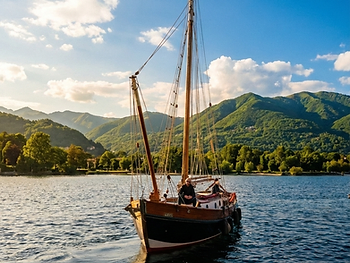
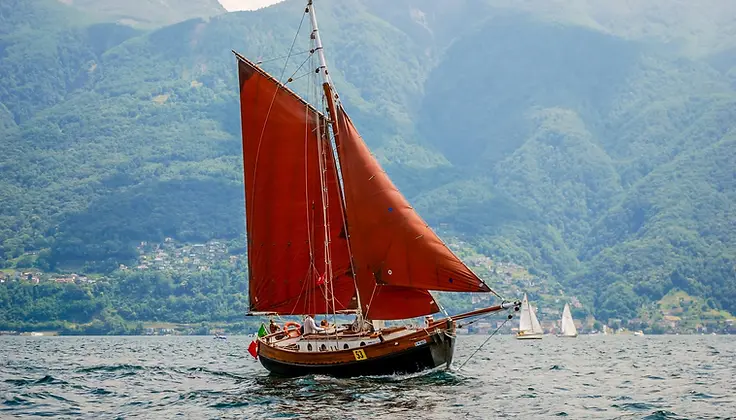
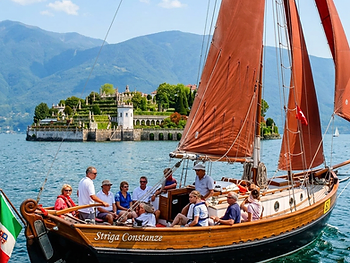
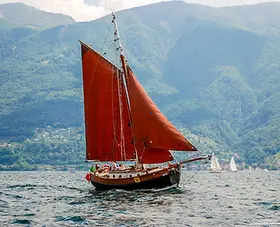
And this is exactly where the Striga Constanze comes in: a traditional gaff cutter with its home port in Laveno-Mombello that makes this depth safe and relaxing to experience – as a private boat tour in a small group, with a personal skipper and at your own pace.
Matching tours
Bestseller€490
Private tour
Proposal€490
Private tour
Beginners€490
+ €20 p. p.Private tourThe depth of Lake Maggiore is the result of a history millions of years old – and it makes the lake one of the most impressive bodies of water between Piedmont, Lombardy and the southern side of Switzerland.
Lake Maggiore has a glacio-fluvial origin. During the last ice ages, glaciers cut deep into the Alpine valley and left a huge basin that filled with water after the ice melted. It shares this origin with other deep Alpine lakes such as Lake Como or Lake Lucerne.
The lake stretches across Switzerland and Italy – from Locarno in the north to Arona and Sesto Calende in the south. About 80.1% of its area lies in Italy, 19.9% in Switzerland. The most important inflow and outflow of Lake Maggiore is the river Ticino.
With a maximum depth of 372 m, Lake Maggiore clearly exceeds Lake Constance and is in the same league as the deepest lakes in Europe. In surface area it is smaller than Lake Garda, but its volume is impressive thanks to its enormous depth.
Although the water surface lies at about 193 m above sea level, the lake bed at its deepest point is about 179 metres below sea level – a so-called cryptodepression. The catchment area of Lake Maggiore covers 6,386 square kilometres.
The greatest depths are found in the middle section between Ghiffa and Laveno. The northern part near Locarno is somewhat shallower and wider, while the southern part widens towards the Po Plain.
Surveying
Surveying such a deep lake is a task that has developed over centuries – and continues to this day.
The first systematic depth measurements took place in the 19th century. At that time, soundings were taken from the shipping company's boats with a rope and lead weight – a laborious but surprisingly accurate method that already confirmed the approximate maximum depth.
Today echo sounders and multibeam sonar systems are used. Hydrological agencies from Switzerland and Italy – such as CNR-IRSA – carry out regular survey campaigns and update the data.
The results go into bathymetric maps showing depth contours (isobaths) in metres. Such maps are published by regional environmental agencies, the World Lake Database and scientific publications – relevant for science, navigation, fishing and tourism.
As skippers on the Striga Constanze we use an on-board echo sounder and know our gaff cutter's draught exactly – it is 1.6 m. In shallow-water zones and when approaching small harbours or anchorages, such data are crucial for safety. In open water, on the other hand, the echo sounder often shows more than 200 m of depth under the keel.
Depth vs. water level
The terms "depth" and "water level" are often confused – but they describe completely different things that matter to every visitor.

Traditional gaff cutter, red sails, just your group. 3, 4 or 7 hours.
from €490
for up to 8 guests at a fixed price, up to 12 on request
The 372 metres beneath the surface are much more than an impressive number – they shape the climate, colours and habitats all around the lake.
The enormous mass of water warms up only slowly in summer and releases the stored heat just as slowly in autumn and winter. The result: a mild, almost sub-Mediterranean climate on the shores of Stresa, Verbania and Laveno, with milder winters than the surrounding area – one of the reasons why exotic plants and gardens thrive here, as admired on Isola Bella or in the gardens of Villa Taranto.
Deep water absorbs more light and reflects less back. On clear days with good visibility the surface therefore appears deep blue to almost "Mediterranean blue" – especially impressive on open water, far from the shallower shore zones. This colour effect is particularly intense on board a sailing boat.
In summer three layers form: a warm surface layer (epilimnion), a transition zone and the cold deep water (hypolimnion). This stratification affects visibility when diving, the distribution of oxygen and living conditions for fish and other animals at different depths.
The depth offers cool refuges for fish in hot summers. The distribution of oxygen depends on how well the layers mix – a process increasingly influenced by climate change.
In cold, windy winters the entire water body can mix – historically documented in 1956, 1963 and 1970, for example. Nutrients are brought up from the depths to the surface and oxygen is carried down into the deep water. In recent decades this has happened less often, as milder winters stabilise the stratification – with consequences for water quality and the region's drinking water.

"Is it dangerous when it's hundreds of metres deep beneath me?" – we hear this question on almost every trip. The answer is clear and reassuring.
From the depths
What lies down there, where no sunlight reaches? The depths of Lake Maggiore preserve stories that only come to the surface after decades or centuries.
The best-known example: the passenger ship «Mercedes» sank on 8 July 1928 and was missing for almost 100 years. The «Mercedes» was found at a depth of 270 metres – discovered by chance by wreck hunters. The wreck lies about one kilometre from the site of the accident, at a depth unreachable for recreational divers. Such finds are only possible with a remotely operated vehicle (ROV) or a special submarine.
The lake's history knows other sunken boats – from wartime, storm accidents or collisions on the once heavily used routes between Locarno, the Brissago Islands and Arona. Local legends tell of "bottomless" spots and mysterious currents said to have pulled ships into the depths.
Important for all guests: such wrecks lie far away from normal swimming spots and boat routes. The areas where people swim, sail or anchor are not affected – here the lake is safe and well charted.
You now know the numbers – but how does the depth of Lake Maggiore actually feel when you're on the water?
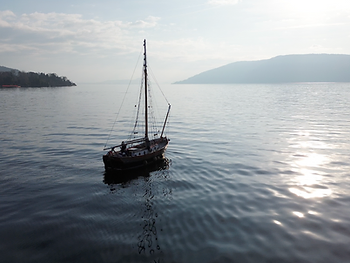
On the open lake, between Laveno and the Borromean Islands, the Striga Constanze glides over water that is often more than 200 metres deep under the keel. In a light breeze you feel a long, gentle swell – quite different from shallow waters, where short waves dominate. The view reaches far, the calm is tangible, and the deep blue beneath the boat gives every trip a special intensity.
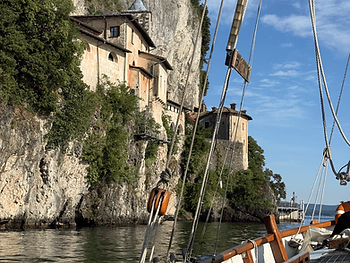
Typical routes lead from Laveno-Mombello past Santa Caterina del Sasso, across to Isola Bella or along the coast towards Pallanza and Cerro – always over the deep basins of the central lake. The contrast between the quiet, shallow bays and the open, dark fairway is one of the most impressive moments of every tour.
On board you can stay relaxed: even when it is several hundred metres deep under the keel, this is a very safe sailing area – without tides, with clearly marked fairways and an experienced skipper who knows the lake. And if you like, you'll get answers along the way to all your questions about depth, water levels, wrecks and the history of the lake. The skipper is not just the helmsman but also your personal guide.
Other providers
Striga Constanze
Mass experience
just your group
Engine noise
sound of wind and water
To-do-list holiday
holiday at your own pace
The fascination of depth appeals to very different people – and each group experiences it in its own way.
They want to understand why such a deep lake creates a mild Mediterranean climate, why palms and camellias grow here and how depth affects fish, animals and plants.
Children are amazed by vivid comparisons – the maximum depth of 372 m is more than three times the height of Milan Cathedral. Wrecks, fish and the "bottomless" water turn every outing into an adventure. Our family tours are designed exactly for this.
The play of light over deep, dark water, sunsets over hundreds of metres of depth, reflections of the mountains – a paradise for every camera and every romantic gaze.
Interest in wind conditions, wave formation on deep lakes, route planning and safety aspects – anyone who sails wants to understand the lake.
Wrecks, shipping history, old surveying techniques, the role of the Palazzo Borromeo and the history of the town of Arona – the lake has more to tell than a while allows.
Most viewed
Bestseller€490
Private tour
Bestseller€490
Private tour
For kids 4–10€490
Private tourInstead of abstract theory, experience the deep lake in person – on a private boat tour with your own skipper and at your own pace.
A compact trip from Laveno-Mombello across the deep areas of the lake. Depending on your wishes, past Santa Caterina del Sasso or towards the Borromean Islands. Short explanations about depth, history and the panorama included.
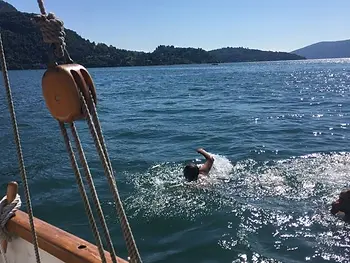
Plus a swim stop in a sheltered, shallow bay – ideal for feeling the contrast between the shallow shore and the deep main basin for yourself. And time for an aperitivo on board.
A flexible day trip with several stops, crossing different basins of the lake, with time for detailed stories about depth, water levels, wrecks and climate. Including a restaurant visit ashore – regional specialities, from breakfast to dinner, depending on the time of day.
All prices are fixed prices for the whole group: up to 8 guests at a fixed price, up to 12 guests on request. Skipper and personal service are always included.

No-obligation enquiry, reply within 24 hours. Weekends in the 2027 season go fast.
No – but the comparison is understandable. The lake naturally has a bottom, but at its deepest point it lies 179 metres below sea level. As a vivid comparison: the maximum depth of 372 m corresponds roughly to the height of the Eiffel Tower plus another high-rise. No wonder the lake seems "bottomless" to many observers.
Season 2027
All the numbers, facts and stories in this article come alive as soon as you're out on the water yourself. Imagine: a quiet evening on the lake, the sun sinking behind the mountains, hundreds of metres of dark, cool water beneath the keel, and your gaze gliding over Isola Bella or the silhouette of Santa Caterina del Sasso. The red gaff sails of the Striga Constanze catch the last of the wind, and for a while the lake belongs to you alone.
Reservations for the 2027 season are possible now – the season starts on 1 March 2027. Turn knowledge into experience: enquire now without obligation and experience the deep Lake Maggiore on a traditional gaff cutter. Authentic. Unforgettable.

Skipper of the Striga Constanze

Ciao! Questions about the route, departure harbour or date? Just message me – I reply personally.